Why Quantum Sits at the Centre of Everything We Build
A reflection from the Physivitis team on World Quantum Day
Today, 14 April, the world marks Quantum Day — a date chosen for the numerical echo of Planck's constant (4.14 × 10⁻¹⁵ eV·s) and now observed across dozens of countries to celebrate the science that quietly runs the modern world. For us at Physivitis, it is more than a symbolic date. Quantum mechanics is the substrate of almost every innovation we have filed, licensed, or put into commercial play over the past two years.
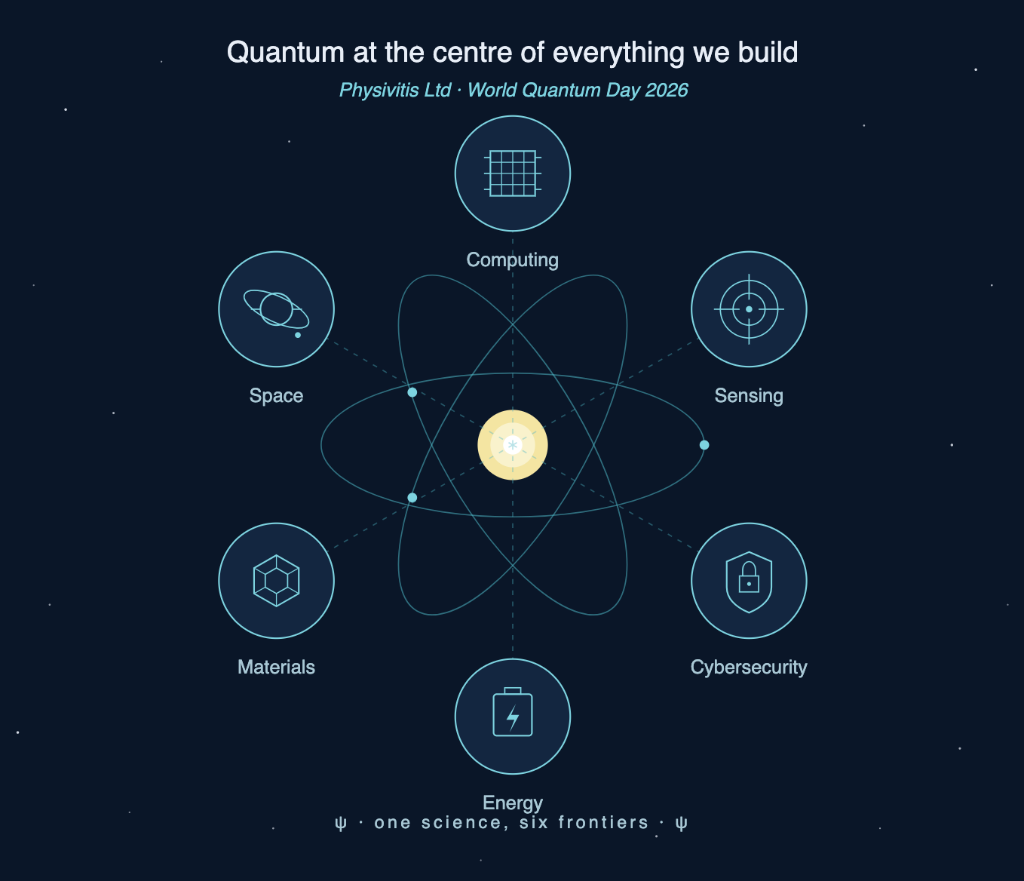
We want to use today to step back from the specifics of any single framework or patent and say something simpler: quantum theory, properly understood and rigorously applied, remains the most productive scientific lens available to engineers, physicists, and technology builders in 2026. It is not a buzzword for us. It is the working language of our portfolio.
A century old, and still the richest frontier we have
Quantum mechanics turned one hundred last year. Its equations, first written down by Heisenberg, Schrödinger, Born, and Dirac between 1925 and 1928, have survived every experimental test thrown at them. What has changed is our ability to engineer around them. We can now cool matter to a few thousandths of a degree above absolute zero; entangle photons across continents; read out single microwave quanta; and manipulate individual electron spins in silicon. Each of these capabilities opens an engineering surface that did not exist a decade ago.
This is the point we keep returning to in our own work. The physics is settled enough to be reliable, and open enough to be generative. Every domain we touch — whether sensing, computing, materials, energy, communications, or cybersecurity — yields new structure when you push its governing equations into regimes where quantum coherence, interference, or statistics dominate the behaviour. That is where the genuinely novel intellectual property lives.
Quantum at the centre of our portfolio
When we audit the innovations that Physivitis has developed and filed, a pattern emerges. It is not that we chose to work on quantum topics as a branding exercise. It is that the hardest, most commercially valuable problems in each vertical turn out to be quantum problems at their core.
In computing infrastructure, the bottleneck is not algorithms; it is the thermodynamics of getting millions of qubits to operate coherently at sub-10 millikelvin temperatures without drowning them in helium-3 or copper cabling. Both of those constraints are quantum in origin, and both admit elegant solutions once you model the joint system properly.
In sensing and detection, the gains no longer come from better optics or faster electronics. They come from exploiting non-classical light, non-Markovian photon statistics, and coherent multi-modal readout — in other words, from taking the quantum nature of the measurement process seriously rather than averaging it away.
In cybersecurity, the entire threat model is shifting. Post-quantum cryptography, quantum key distribution, and quantum-resilient authentication are not speculative concerns for some distant decade; they are procurement questions being asked by defence primes and financial institutions this year.
In energy and materials, the opportunities we see in battery chemistry, in aluminium-graphene conductors, and in photonuclear dissipation all reduce to the same question: what happens when you engineer the electronic structure of a material, atom by atom, informed by the full quantum description rather than a classical approximation? The answer, repeatedly, is an order-of-magnitude improvement in some figure of merit that the classical picture said was a hard ceiling.
In space and communications, quantum-geometric framing of satellite links, unjammable channels based on entanglement, and positional encodings derived from quantum resource theory are reshaping what a communications payload can do. These are not incremental upgrades; they change the threat surface and the capability envelope simultaneously.
Why this matters beyond our own work
We think the wider lesson of Quantum Day is that the separation many people still draw between quantum science and classical engineering is dissolving. The next generation of batteries, radars, chips, sensors, medical imagers, and secure networks will be designed by teams fluent in quantum theory, even when the end product does not wear the quantum label on its sleeve. The pipeline from fundamental physics to shipping product has compressed dramatically, and companies that internalise that shift will compound advantages quickly.
This also has implications for talent, for policy, and for capital allocation. The United Kingdom, where Physivitis is incorporated, sits on a genuine national advantage here: deep university physics, a mature patent system, and a regulatory environment that is increasingly willing to back quantum industrial strategy. Sustaining that advantage requires keeping the pipeline from lab to licensee short and clear, and treating quantum engineering as a general-purpose capability rather than a niche.
Our commitment
At Physivitis, our model is deliberately simple. We identify gaps in existing physics frameworks, express them in rigorous mathematics, synthesise across domains, and commercialise the resulting intellectual property through licensing partnerships with OEMs, defence primes, and enterprise licensees. We do not manufacture hardware. We build the frameworks that let others manufacture better hardware, and we licence them on terms that reward the underlying science.
Quantum mechanics is the connective tissue that runs through almost every framework in our portfolio. Whether it is the chronology-protection inequality we provisionally patented earlier this year, the battery performance optimiser we launched commercially last week, or the detection laws and cryogenic architectures we are preparing to move into lab validation, quantum reasoning is the common thread.
On this Quantum Day, our message to partners, investors, and fellow builders is straightforward. The frontier is not closing; it is widening. The ratio of what quantum theory predicts to what we have engineered around is still enormous, and most of the commercially interesting territory in the next decade will be claimed by teams that treat quantum as a working tool, not a marketing category.
We are grateful for the scientists, past and present, whose work makes any of this possible, and we are committed to carrying that tradition forward — one rigorously derived framework at a time.