How looking for a missing soldier led us to something that may help our parents
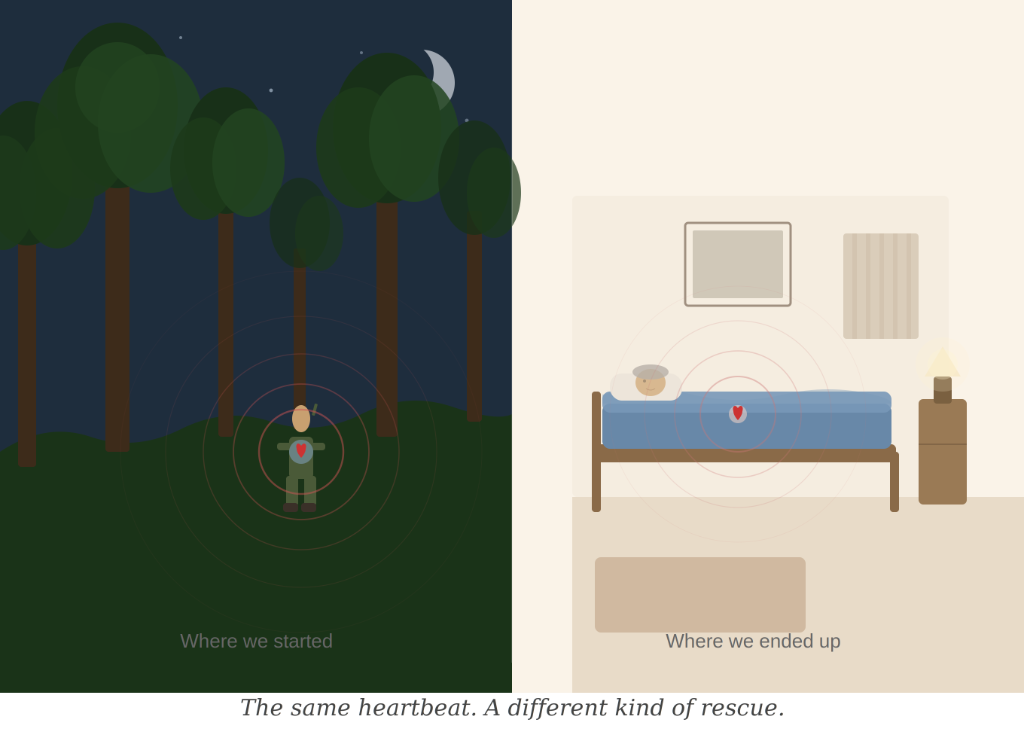
It started with a story I read over the Easter weekend.
An American serviceman had gone missing after an incident in Iran, and after days of searching he was found alive. The detail that stopped me was how. Not by sight, not by sound, not by any of the obvious things. By a sensor that could pick out the beat of his heart from a distance, somehow filtering out wind, vehicles, and everything else moving around him to find the one signal that mattered: a person who was still alive.
I could not stop thinking about it.
Something about that idea moved me. A machine that values human life enough to listen for the smallest signal a body produces and insists on finding it. A machine that says, in effect, you are not lost to us. We will find you.
I wondered whether we could build one. Not the same one, but a better one. Whether a small team in London, with the right physics and enough determination, could do something that was already being done in classified labs somewhere with budgets we will never see.
I called a few colleagues. Other physicists, an engineer, a coder I trust. We agreed to give ourselves the Easter weekend. By Monday evening we would either have a sketch of how to do it, or we would put the idea down and go back to our other work.
We missed the deadline.
Easter came and went. We had filled whiteboards, drained pots of coffee, argued late into the nights, but what we had at the end of the weekend was a pile of partial ideas that did not yet add up to anything. We extended into the following week. And then into the week after that.
Eventually we had something. Not a finished invention, but a framework — a set of instructions a computer could actually follow, a way of testing whether the idea worked. We built it as a simulation, the way physicists usually do before any hardware exists, because it is much cheaper to find out you are wrong on a screen than in a workshop.
We fed the simulation the kinds of conditions a search-and-rescue team would actually face. A person hidden in dense forest. A person under rubble. A person far away from the sensor with wind moving everything around them. Difficult conditions. The conditions that matter.
And here is where the story takes a turn I did not expect.
Our method, in those very difficult search-and-rescue conditions, performed about as well as the existing approaches. Sometimes a little better, sometimes a little worse. The physics of finding a faint signal at a long distance through heavy obstacles sets a limit, and we did not break that limit. That part of the story is honest. We had set out to make a search-and-rescue tool, and we ended up with something that was not dramatically better than what already exists for that job.
But we kept testing. And when we ran the same method in a completely different setting — the kind of quiet conditions you find in a hospital room or in someone's living room at night — the results were different. Not slightly different. Categorically different.
In the kind of room where an elderly person sleeps, where a son or daughter worries from far away about whether their parent is all right, where a care home struggles to know which of their residents needs help in the next minute, our method appeared to do things the existing technology cannot reliably do. It could keep watch over two people in the same room and tell them apart. It could pick out the signs of cardiac trouble before they became a crisis. It could distinguish a human from a pet, a heartbeat from a fan.
The technology that already exists in this space is built by big companies. Names you would know if you follow consumer electronics. Their devices are in care homes today, in hospitals, in cars. They work, but they have well-known limits — the kind of limits that make a son driving home at 11 p.m. wonder whether the alarm that just rang was real or whether the system mistook the cat for the cat's owner.
Our method, in simulation, addressed those limits. I want to be careful here. Simulation is not the real world. We have not yet run our method on physical hardware in a real room with a real person. That step is the next one, and we are preparing for it. Until that test is done, the proper word for our results is promising, not proven.
But the pattern is clear enough that we are not going to wait quietly to share it. Too many families are wrestling with this problem right now. Too many people are watching from a distance, hoping the technology that is supposed to help them will perform when it matters.
I set out trying to build something that could find a soldier lost in a war zone. What I appear to have ended up with is something that may help an old woman who is on her own at night, in her own bed, in her own home, and is loved by people who cannot always be there with her.
I did not see this coming. Physics has a way of rearranging itself around the problems it actually finds, rather than the problems you started looking at. The search-and-rescue work continues. We will return to it. But the next thing we are going to build, and the next thing we are going to test on real hardware, is the one that matters most for the people who are quietly waiting for it.
Want to be part of this work?
If you build technology in this space, or work in care, or invest in companies that try to make life safer for older people, we would welcome a conversation.
Get in Touch