Helium-3: Scarcer Than Gold, Critical to Every Quantum Computer.
Physivitis Has Made It Obsolete.
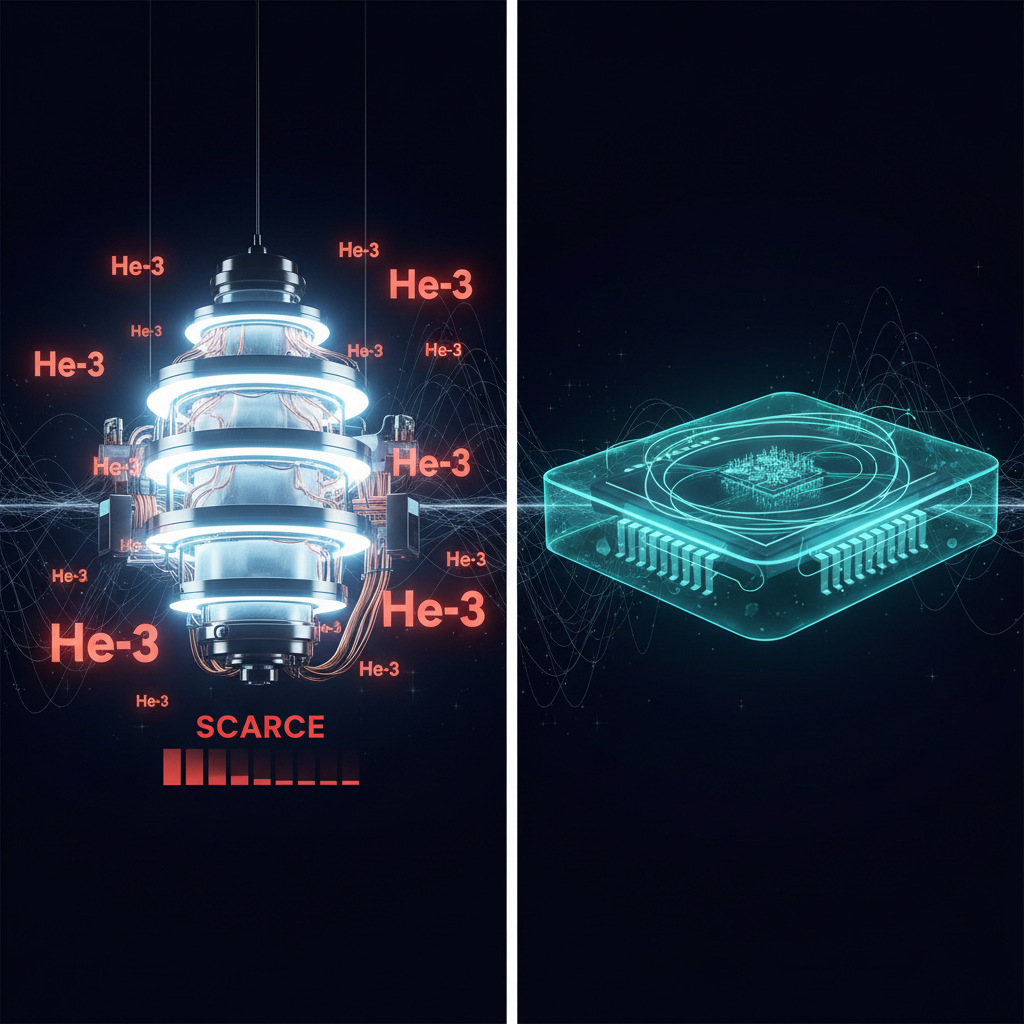
The quantum computing industry has a dependency it cannot sustain. Not on chips. Not on algorithms. Not on talent. On a gas.
Helium-3 is the lifeblood of quantum refrigeration. Without it, the dilution refrigerators that cool superconducting quantum processors to near absolute zero cannot function. Without those refrigerators, the qubits do not work. Without the qubits, there is no quantum computer.
And Helium-3 is running out.
A Gas Scarcer Than Gold
Helium-3 does not exist in any meaningful natural quantity on Earth. It is produced almost exclusively as a byproduct of nuclear weapons programmes, through the radioactive decay of tritium. Global supply is estimated at 15,000 to 20,000 litres per year. That number is not growing. The nuclear programmes that produce it are not expanding. There are no commercial mines, no industrial synthesis routes, and no viable recycling process that can keep pace with demand.
The price tells the story. Helium-3 costs between $2,000 and $15,000 per litre. Per gram, it trades at approximately $150,000. Gold, by comparison, trades at roughly $120 per gram. The rarest gas in quantum computing is literally more valuable than gold.
Every superconducting quantum computer built by IBM, Google, Amazon, Intel, and Microsoft depends on this gas. Every one of the 1,500+ dilution refrigerators installed worldwide by Bluefors alone consumes it. And as the industry scales from hundreds of machines to thousands, and then to tens of thousands, the supply equation breaks.
This is not a forecast. It is already happening.
When the Solution Is the Moon, the Problem Is Serious
In September 2025, Bluefors, the world's dominant dilution refrigerator manufacturer, announced a deal with Interlune, a Seattle-based lunar mining startup, to purchase up to 10,000 litres of Helium-3 per year. The source: the Moon's surface, where Helium-3 has been deposited by solar wind over billions of years. Deliveries are scheduled to begin in 2028.
Consider what that means. The company that builds the cooling systems for most of the world's quantum computers has concluded that the best available path to securing its essential raw material is to mine it from another celestial body and ship it 384,000 kilometres back to Earth.
DARPA has reached a similar conclusion from the defence side. In late 2025, the agency issued a formal Request for Information seeking sub-kelvin cryocoolers that do not require Helium-3. NATO has classified Helium-3 dependency as a critical vulnerability across the alliance's quantum infrastructure. The UK government has invested £51.2 million in a National Cryogenic Facility at Daresbury Laboratory, recognising that cryogenic capability is a matter of national strategic importance.
The entire industry is sending the same signal: the current cooling model is unsustainable.
"Not 'where can we find more Helium-3?' but 'what if quantum computers did not need it at all?'"
A Different Answer to the Same Question
The industry's response to the Helium-3 crisis has focused overwhelmingly on the supply side: find more of it, recycle it more efficiently, or extract it from space. These are legitimate strategies. But they share a common limitation. They accept the dependency as a given and try to manage the scarcity.
At Physivitis, we asked a different question. Not "where can we find more Helium-3?" but "what if quantum computers did not need it at all?"
We have developed a proprietary approach to millikelvin cooling that does not use Helium-3 at any stage. Not reduced Helium-3. Not recycled Helium-3. Zero.
The result is continuous cooling performance at temperatures required for superconducting quantum computing, achieved through a completely different route. We are not disclosing the technical details publicly at this time, but we are in active discussions with potential co-development partners and are happy to present the full architecture under appropriate confidentiality agreements.
What This Changes
Removing Helium-3 from the quantum cooling chain does not solve one problem. It unlocks a series of possibilities that the industry has been forced to treat as out of reach.
Quantum computing scales on its own terms.
Today, scaling quantum computing means scaling Helium-3 consumption — and that does not scale. Remove the dependency, and the quantum roadmaps of every major hardware company are no longer gated by an isotope they cannot manufacture.
The cost of cooling drops.
Helium-3 is one of the most expensive line items in quantum hardware. Our approach uses inputs that are commercially available, widely sourced, and stable in price. The economics of quantum infrastructure change fundamentally when the rarest input is removed.
Supply chain risk is eliminated, not managed.
The Bluefors-Interlune deal is a hedge. It manages the risk. Our approach eliminates it. No dependency on nuclear weapons programmes. No geopolitical exposure. No reliance on lunar mining timelines that have never been tested.
Quantum technology reaches places it could not go before.
Space-based quantum sensors and secure communications payloads need millikelvin cooling in orbit. Current solutions are impractical for long-duration missions. An approach that removes the need for scarce consumable gases opens the door to persistent quantum capability in space.
Medical imaging breaks free from helium constraints.
MRI systems worldwide face chronic helium supply challenges. Elements of our work have applicability to medical cooling, reducing the healthcare sector's dependency on helium and improving access in resource-limited settings.
Fundamental physics experiments can grow.
The world's leading dark matter and neutrino experiments require millikelvin cooling for large detector masses. Every one of them depends on Helium-3. An alternative that removes this constraint could accelerate some of the most important experiments in modern physics.
Built in Britain. For the World.
We develop proprietary technology frameworks across quantum computing, sensing, cybersecurity, energy, and space applications.
The UK has made significant commitments to quantum technology, from the National Quantum Strategy to the National Cryogenic Facility. What the UK has not yet had is a homegrown answer to the Helium-3 problem. We believe Physivitis provides that answer.
Whoever solves Helium-3-free millikelvin cooling will hold one of the most valuable positions in the quantum technology landscape for the next two decades.
The Conversation Is Open
We are actively engaging with co-development partners: cryogenics manufacturers, national laboratories, government agencies, and quantum hardware companies. We welcome conversations with organisations that recognise the Helium-3 problem and are serious about solving it.
The Helium-3 crisis is not coming. It is here. The quantum industry knows it. DARPA knows it. NATO knows it. Bluefors knows it well enough to sign a deal to mine the Moon.
Physivitis has built the alternative.
Interested in co-development?
We are engaging cryogenics manufacturers, national laboratories, government agencies, and quantum hardware companies. All technical discussions are conducted under NDA.
Start the Conversation